

There is no single best field guide, because the guides make different trade-offs: paintings or photos, one book or two regions, pocket size or reference size. This page sticks to what the publishers and authors say about their own books. We do not quote prices (they change, and we do not want to guess), and we do not give star ratings. We have not read these cover to cover, so we will not claim which has the "best" art or text.
At a glance
| Book | Best for | Publisher-stated facts | Features the publisher highlights |
|---|---|---|---|
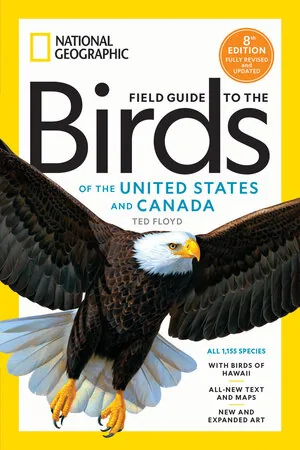 National Geographic Field Guide to the Birds of the United States and Canada, 8th ed. (Ted Floyd) | Whole US and Canada in one book, plus Hawaii | 1,155 species; 592 pages; published Sept. 9, 2025; paperback | Range maps built with eBird data; annotated art with field marks; thumb tabs and a visual index |
 The Sibley Field Guide to Birds of Eastern North America, 2nd ed. | Birders east of the Rocky Mountains | 650 species; 466 pages; flexibound; March 2016 | Paintings with field-mark captions; maps for winter, summer, year-round, migration and rare ranges |
 The Sibley Field Guide to Birds of Western North America, 2nd ed. | Birders in the Rockies and west, including Alaska and western Canada | 715 species; 504 pages; flexibound; March 2016 | Same art and map style as the Eastern guide, with western regional detail |
 The Sibley Guide to Birds, 2nd ed. (the "big Sibley") | Home reference; birders who want every species and variation | 624 pages; published March 11, 2014; the maker says it covers over 900 species | Larger art and maps than the field-guide editions; habitat and voice text for every species |
 Peterson Field Guide to Birds of North America, 2nd ed. | Birders who like the classic Peterson identification system | Houghton Mifflin Harcourt; April 7, 2020 | 25 new plates covering the birds of Hawaii; updated text and range maps |
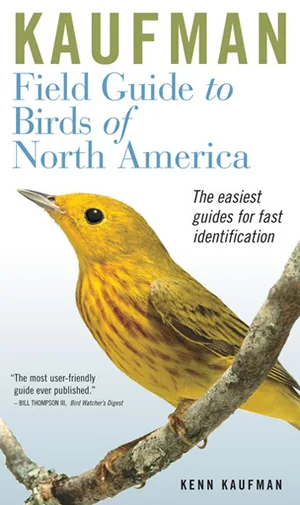 Kaufman Field Guide to Birds of North America | Beginners who want photo-based pages in a compact size | Houghton Mifflin; 2005 printing (first published 2000); compact size, per the author | Species grouped by appearance; pictorial table of contents; color tabs; one-page quick index |
Sources are listed at the bottom of the page. "Best for" is our reading of each publisher's description, not a test result.
Which guide for which birder?
One book for the whole US and Canada: National Geographic, 8th edition
Penguin Random House describes the 8th edition as completely revised, with all-new text by Ted Floyd (editor of the American Birding Association's Birding magazine), updated taxonomy, 240 new illustrations and new range maps developed with eBird data from the Cornell Lab of Ornithology. For the first time it includes Hawaii as well as Alaska, Canada and the continental US, 1,155 species in total. It is a 592-page paperback with larger pages than earlier editions, thumb tabs and a visual index inside the covers.
Trade-off: one book covering everywhere means it is a bigger book than a regional pocket guide. Whether the larger pages bother you in the field is something to check in a shop.
The Sibley guides: East or West
David Sibley's guides are illustrated with his own paintings, with captions pointing out field marks. The author's site explains the choice clearly: the Rocky Mountains form the dividing line, so a state or province in or west of the Rockies belongs with the Western guide, and one entirely east of them belongs with the Eastern guide. Texas is the one state split between them: the author says the Eastern guide is the best choice for most Texas birders, while a few species common in far-west Texas appear only in the Western guide.
- Eastern guide: 650 species, 466 pages. The author lists Ontario, Quebec, the Maritime provinces, Newfoundland and Labrador and Saskatchewan among the places where it works best.
- Western guide: 715 species, 504 pages. The author lists Alaska, Alberta, British Columbia and the Yukon, plus the western states.
- Size: the author says the regional guides are just under 5 by 8 inches and under 1.5 pounds, so they fit into many pockets.
- Hawaii is not covered by any Sibley guide.
If you want the big Sibley Guide to Birds instead, the author's own comparison says it is more of a reference book, covering over 900 species with larger illustrations and maps, at roughly 6.25 by 9.75 inches and about 2.5 pounds, so it "generally has to be carried in a backpack or other bag." The regional field guides drop some rare species and some less-seen variations to save space. Note that the regional guides (2016) are newer than the big guide (2014) and include a few introduced species it does not.
Peterson, the classic
The Peterson Field Guide to Birds of North America second edition (Houghton Mifflin Harcourt, April 2020) is described by its publisher as a new edition with 25 all-new plates covering the birds of Hawaii, updated text and range maps, and touched-up art. It is the guide that built the famous Peterson identification system, and if you grew up with a Peterson you will feel at home.
Kaufman, for beginners who like photographs
The Kaufman Field Guide to Birds of North America uses digitally edited photographs rather than paintings and arranges birds by appearance instead of strict scientific order, so similar-looking birds sit next to each other. Its author's page describes a pictorial table of contents, color tabs and a one-page quick index. Be aware that the current printing is from 2005, so species names, splits and range maps will be older than in the 2016 to 2025 books above. It is still a friendly way in, but check whether the species you see locally are covered.
Where Merlin fits in
Cornell's Merlin Bird ID is free, and Cornell says it offers Sound ID, Photo ID and step-by-step ID, and that it is powered by eBird so it can build lists of birds likely near you. Cornell says Sound ID and Photo ID work offline once you have downloaded the bird packs you need. A book and an app do different jobs: the app is fast for "what is that?", while a printed guide never runs out of battery and shows you the bird next to its look-alikes. Our app comparison covers the others, including the Sibley app, which the author says includes the content of his books.
How to choose
- You bird in one region and want a pocket book: the Sibley guide for your half of the continent.
- You travel across the US and Canada, or you want Hawaii: National Geographic 8th edition or Peterson second edition, since both state that Hawaii is included.
- You prefer photos to paintings: Kaufman, accepting that it is older. National Geographic's 8th edition uses illustrations, as the publisher describes it.
- You want everything in one reference at home: the big Sibley.
- You are not sure: look at pages in a bookstore or library first. Art style is personal, and it is the thing that decides which book you actually open.
Before you buy
- Check the edition. Older printings turn up used and online. Publishers' pages above list the current editions and dates.
- Check availability and the current price with the seller. At the time we checked, one publisher page listed the Peterson as out of stock on its own store, so you may need another seller. We list no prices here.
- Going out with a book? Bring binoculars too. Starting out? See our beginner gift guide.
Sources, all checked October 25, 2026 (America/New_York): Penguin Random House: National Geographic 8th edition; Penguin Random House: The Sibley Guide to Birds; Sibley Guides: Eastern and Western; HarperCollins: Peterson (on-sale date and the Hawaii plates); Kaufman Field Guides (features, 2005 printing and 2000 first publication); Merlin Bird ID. We have not tested or compared the books ourselves.