Binoculars handle most birding. A scope earns its place when birds are far away: ducks out on a lake, shorebirds on a mudflat, a hawk on a distant snag. Audubon's Kenn Kaufman writes that for those situations "even the best binoculars won't do the trick." If you do not own binoculars yet, start with our binocular picks and our 8x42 vs 10x42 guide, then come back.
We do not list prices or star ratings, and we have not tested these scopes ourselves. Specs below are copied from each maker's own page. Advice comes from Audubon's scope-buying guide (Kenn Kaufman, December 2017) and Cornell Lab's scope guide (published 2007, so its price comments are dated, but its optics advice still holds up).
Angled or straight?
Both Audubon and Cornell lean toward angled for most birders. You look down into the eyepiece at about 45 degrees.
- Sharing: set the tripod for the shortest person and taller people just lean over.
- Looking up: an angled eyepiece works better for birds overhead.
- Shorter, steadier tripods: Cornell notes angled scopes work with shorter tripods, which are inherently more stable.
- Sketching: Kaufman says it is easier to look back and forth between scope and sketchbook.
Choose straight if you mostly bird alone and have a sturdy, tall tripod: Audubon says you can set it to eye level and scan for long periods, and Cornell notes straight-through is the natural way to locate and follow a subject.
65 mm, 80 mm or bigger?
With scopes, the big number is the front lens (objective) diameter. Audubon says many of the most popular birding scopes are 50 to 80 mm; Cornell says typical values run from about 50 to 100 mm. Bigger lenses let in more light and give brighter images, but they add weight and bulk. Cornell recommends at least 60 mm for a bright image, and about 85 mm if you plan to do a lot of digiscoping (holding a phone or camera to the eyepiece).
The Celestron Regal M2 line makes a handy comparison because it comes in 65 and 80 mm versions with the same design (below). The 80 mm model gives up about 8 oz and some close-focus ability for the extra light-gathering.
Watch out for: a bigger scope you leave home is worse than a smaller one you carry. Be honest about how far you hike.
Three scopes, compared
 Celestron Regal M2 16-48x65 ED | Celestron Regal M2 20-60x80 ED | Vortex Diamondback HD 20-60x85 | |
|---|---|---|---|
| Design | Angled | Angled | Angled or straight (separate models) |
| Objective lens | 65 mm | 80 mm | 85 mm |
| Zoom eyepiece | 16-48x | 20-60x | 20-60x |
| Low-dispersion glass | ED objective | ED objective | HD optical system |
| Field of view at 1,000 yd | 131-68 ft | 110-52 ft | 108-60 ft |
| Eye relief | 20 mm (at 16x) | 20 mm (at 20x) | 18.3-20.3 mm |
| Close focus | 16.4 ft (at 16x) | 21.3 ft (at 20x) | 24.6 ft |
| Weight, ready to use | 58.2 oz (with eyepiece) | 66.6 oz (with eyepiece) | 60.9 oz angled; 61.3 oz straight |
| Waterproof, fog-proof | Waterproof, nitrogen-filled | Waterproof, nitrogen-filled | Waterproof, argon-purged |
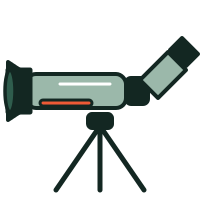
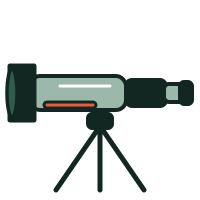
The scope drawings are our own generic illustrations, not photos of these models.
Sources: Celestron Regal M2 16-48x65 ED, Regal M2 20-60x80 ED, Vortex Diamondback HD 20-60x85 angled and straight. Celestron lists weights both with and without its eyepiece; we show the with-eyepiece figure. Vortex lists a single weight per model.
Celestron Regal M2 ED (65 mm and 80 mm)
Celestron describes the Regal M2 as having an ED objective lens, XLT fully multi-coated optics, a magnesium alloy body, dual (coarse and fine) focus, and a rotating tripod mount. Both list a standard 1.25-inch eyepiece mount and an included T-Adapter for attaching a camera. Celestron's product pages show a "Limited Lifetime Warranty" badge; read the terms there. Both are waterproof and nitrogen-purged to prevent fogging. Both of these are angled models.
Watch out for: the 80 mm's 21.3 ft close focus is slightly farther than the roughly 20 feet Audubon says a birding scope should ideally reach. The 65 mm's 16.4 ft clears that bar. That matters if you want to study hummingbirds at a feeder from a few yards away.
Vortex Diamondback HD 20-60x85
Vortex sells this model in both angled and straight versions with matching optics. It lists an HD optical system, fully multi-coated lenses, a helical focus, rubber armor, argon purging, and Arca-Swiss compatibility for direct mounting on compatible tripod heads. The page lists wildlife observation among recommended uses alongside hunting.
Watch out for: it has the farthest close focus of the three (24.6 ft), and the 85 mm objective makes it the largest one here.
A premium option to look at
If you want to step up, Kowa's TSN-550 Prominar series uses a 55 mm pure fluorite crystal objective in an ultra-compact body. Kowa pitches the line at people who want to travel light. We have not compared its full specs, so check Kowa's page and try one in person.
Eyepieces: zoom or fixed?
Audubon and Cornell agree: a zoom eyepiece is often the best choice for birding. Start at the lowest power to find and center the bird, then zoom in to study it. Audubon lists 20-40x, 20-60x and 25-50x as popular zooms. If you buy a fixed eyepiece, both say 20x to 30x is the most useful general range. Heat shimmer and vibration often obscure the view at higher powers, and Cornell cautions about fixed eyepieces above 45x unless they are top quality.
Watch out for: Cornell says zooms do not gather light as well as fixed eyepieces and that cheap zooms lose light and give poor views at middle and high power. Higher magnification also narrows the field of view.
Glass quality: ED, HD, fluorite
Cornell says top scopes use fluorite-coated, HD or ED glass, and the difference is most noticeable in low light and at high power. Audubon explains that ED stands for "extra-low dispersion," which reduces the color fringing (chromatic aberration) around objects, and warns that makers use different terms for it, including HD, XD and APO. Audubon's advice if you must choose between better glass and more power: the sharpest, clearest image is always the more satisfying one. Also look for multi-coated lenses, which Audubon calls the top standard.
Eye relief for glasses wearers
Cornell says generally 12 to 15 mm of eye relief is adequate for most eyeglass wearers. All three scopes in our table list at least 18 mm. Cornell also notes that many scopes have folding or movable rubber eyecups for people who do not wear glasses.
The tripod matters as much as the scope
Cornell: "Even the brightest, crispest, most powerful scope won't provide a good image if it's mounted on a flimsy tripod." Both sources recommend:
- A rigid, sturdy tripod, firm enough for a steady view in wind, with as few leg adjustments as possible. Flip locks are quick to use.
- One that extends high enough to put the scope at a comfortable eye height for long sessions (especially with a straight scope).
- Budgeting for it up front. Audubon says not to forget the tripod's cost when you set your scope budget.
We do not recommend specific tripods yet, because we have no verified specs for any. Audubon says birding does not require a tripod as rock-solid as photography does, but it should hold steady in the wind.
Don't buy an astronomy telescope
Cornell's one tip up front: do not try to use an astronomy telescope for birding. Magnification is usually too high, they are hard to sight through, and they are often not weatherproofed.
Try before you buy
Audubon: no amount of spec-reading replaces trying one. Nature centers, wild bird stores and big birding festivals often have several models to compare. Check how the focus feels (a ring on the barrel, or a knob), how the scope sits on your tripod, and how close it focuses.
Our short checklist
- Angled, unless you bird alone with a tall tripod.
- Objective 65 to 85 mm; closer to 85 if you will digiscope or bird at dusk.
- 20-60x (or similar) zoom from a maker you trust, with ED or HD glass.
- Close focus at or under about 20 ft if you will watch feeders. See our feeder guide.
- A real tripod and head, budgeted from day one.
- An ID app on your phone: compare birding apps here.
Sources, all checked October 25, 2026 (America/New_York): Audubon: How to choose your spotting scope; Cornell Lab: How to choose a spotting scope; Celestron; Vortex; Kowa.