
A smart feeder is a bird feeder with a camera and an app. You get photos and clips of whoever visits, alerts, and usually automatic species identification. They are fun, but they are not magic: they are still feeders (see our beginner feeder guide), and they need the same regular cleaning. We link to the makers' own pages and list no prices, because they change often and several makers run frequent sales.
Netvue vs Birdfy: the same company
You will see "Netvue Birdfy" bird cameras on Netvue's site. Birdfy's About page says the brand grew out of Netvue, a security-camera maker founded in 2010, and that the first Birdfy Feeder launched in November 2021. Netvue still lists a Birdfy camera on its own store. So we compare Birdfy (made by Netvue) against Bird Buddy.
Watch out for: the two company sites do not describe the AI subscription identically. Netvue's listing describes a "Birdfy Lite" device and says an AI subscription is required (with monthly, annual or lifetime upgrade options), while birdfy.com offers an "AI Lifetime Free" version alongside an "AI by Subscription" version of the Birdfy Feeder. These may be different bundles, and we have not verified the exact terms of each, so check the page you are buying from.
At a glance
Birdfy sells a much larger lineup than the one model below (its pages list Feeder 2, Feeder Metal 2 with 4K video, and others). We compare the original Birdfy Feeder because it has a complete official spec sheet we could verify. Bird Buddy's current feeders are the Nook, Nook Solar and Home.
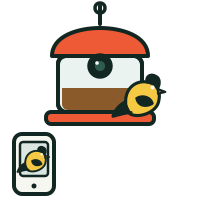 Birdfy Feeder | 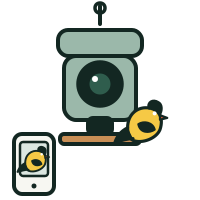 Bird Buddy Nook | 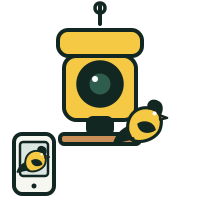 Bird Buddy Home | |
|---|---|---|---|
| Maker | Birdfy (grew out of Netvue) | Bird Buddy | Bird Buddy |
| Video, per maker spec page | 2K (2304x1296) at 20 fps in high-quality mode; 1080p at 30 fps in standard mode | Full HD, HDR | Full HD, HDR (see note below) |
| Photos | Not listed on the spec page | 5 megapixel, HDR | 5 megapixel, HDR |
| Night vision | Infrared or white light | Not listed on the spec page | Not listed on the spec page |
| Audio | Two-way audio | Built-in microphone | Microphone and speaker |
| Power | 5200 mAh battery; optional solar panel | 3900 mAh battery; solar version (Nook Solar) has a detachable solar roof | 3900 mAh battery |
| Seed capacity | 50 oz (1.5 L) | 3.8 cups (0.9 L) | 6 cups (1.4 L) |
| Weather rating | IP65 | IP67 | IP67 |
| Wi-Fi | 2.4 GHz | 2.4 GHz | 2.4 GHz and 5 GHz |
| Weight | 3 lb (1.35 kg) | 2.98 lb (1,351 g) | 2.04 lb (925 g) |
| Operating temperature | 14°F to 113°F | -5°F to 120°F | -5°F to 120°F |
| Local (microSD) replay | Not available | Not listed on the spec page | Not listed on the spec page |
The feeder drawings are our own generic illustrations, not photos of these products.
Sources: Birdfy Feeder specifications; Bird Buddy Nook specifications; Bird Buddy Home specifications. "Not listed" means the maker's spec page does not say, not that the feature is missing.
Birdfy Feeder (made by Netvue)
The Birdfy Feeder is the model that started the category. Birdfy says it offers 2K video in high-quality mode, color night vision, a battery rated up to three months on a charge at 10 videos a day (a maker claim, not our test), support for 20+ guest accounts, and a two-year warranty. It has a flip-open lid and a seed bin that disassembles for cleaning. A solar panel is optional.
Birdfy's product page says its AI auto-identifies "6,000+ bird species" (a marketing figure we cannot check), with a 7-day free trial and then a subscription, unless you pick the "AI Lifetime Free" option.
Watch out for: there is no microSD replay (per the spec page), it uses 2.4 GHz Wi-Fi only, and Birdfy's own solar-bundle page lists 1080p video rather than the 2K the base feeder's page headlines, so confirm which bundle gets which video mode.
Bird Buddy Nook and Nook Solar
The Birdbuddy Nook Solar is Bird Buddy's entry-level smart feeder; the plain Nook skips the solar roof. Per the spec page, it has a 1/2.8-inch sensor, Full HD HDR video, 5-megapixel photos, portrait and landscape modes, a 3900 mAh battery, IP67 weather resistance and a 3.8-cup seed capacity. The Nook Solar adds a detachable solar roof with one panel that can face either direction.
The free app tier gives you photos, video and livestream with manual bird identification. Per Bird Buddy's own comparison, automatic species identification, naming your regulars and tracking their visits are part of Premium.
Watch out for: the smaller seed capacity means more frequent refills, and the Nook's perch is not compatible with the 3-in-1 nutrition set (jelly tray, fruit stake, water fountain), per the spec page.
Bird Buddy Home
The Birdbuddy Home is the roomier Bird Buddy: a 6-cup seed capacity, a built-in speaker in addition to a microphone, dual-band Wi-Fi (2.4 and 5 GHz) and a lighter body than the Nook. Camera hardware matches the Nook on paper (spec page).
Watch out for: Bird Buddy's Home product page advertises "2K video," while its support spec page says Full HD. Bird Buddy's membership page lists "2K Ultra Resolution" as a Premium benefit, which may explain the gap, but we have not confirmed that, so treat the 2K claim as unverified.
What the subscription actually does
Bird Buddy publishes a plain free-vs-paid comparison on its Premium page:
- Free: photos, video and livestream, manual species recognition, and one Nature Chat prompt a day.
- Individual or Family Premium (billed yearly): automatic AI recognition, Name That Bird (naming your regulars), unlimited Nature Chat, "2K Ultra Resolution," bird-health alerts, and membership discounts. Family adds access for up to 10 guests.
Birdfy's structure is different: the AI is sold as a choice between a subscription and a lifetime-free version at purchase. We have not verified what is included in each, so read the FAQ on the product page.
Either way, budget for a recurring fee if you want hands-off species ID, and check the current price on the maker's page. Trial lengths are not consistent across Bird Buddy's own pages (one says one week, a product page says one month), so confirm at checkout.
Which one should you get?
- You want a big seed bin and a wide range of models and add-ons (solar panels, poles, extensions): look at Birdfy, and decide up front whether you want the subscription or lifetime-free AI option.
- You want Bird Buddy with more room and 5 GHz Wi-Fi: the Home holds 6 cups versus the Nook's 3.8, and its camera specs match the Nook's on the spec pages. Birdfy's 50 oz (about 6.3 cups) bin is in the same range.
- You want the lowest-commitment way in: the Bird Buddy Nook with the free tier and manual ID. You can add Premium later.
- Not sure you will keep it up: start with a plain tube feeder and a pair of binoculars. The birds do not care which one you pick.
Before you buy any camera feeder
- Check your Wi-Fi where the feeder will hang. The Birdfy Feeder and Bird Buddy Nook list 2.4 GHz only (the Home adds 5 GHz), and weak signal at the far end of a yard is a common problem.
- Plan to clean it. Cornell recommends cleaning seed feeders about every two weeks, and the same goes for cameras with seed bins. Pick one you can take apart. See our seed guide for what to put in it.
- Squirrels. A camera does not stop them. Mount it on a pole with a baffle where you can.
- Marketing numbers are not tests. Battery life, species counts and "AI accuracy" are the makers' claims.
Sources, all checked October 25, 2026 (America/New_York): birdfy.com Birdfy Feeder; Birdfy specs; Birdfy About; netvue.com Birdfy listing; Bird Buddy Nook Solar; Bird Buddy Home; Bird Buddy Premium. Product lineups and subscription terms change often.